Context
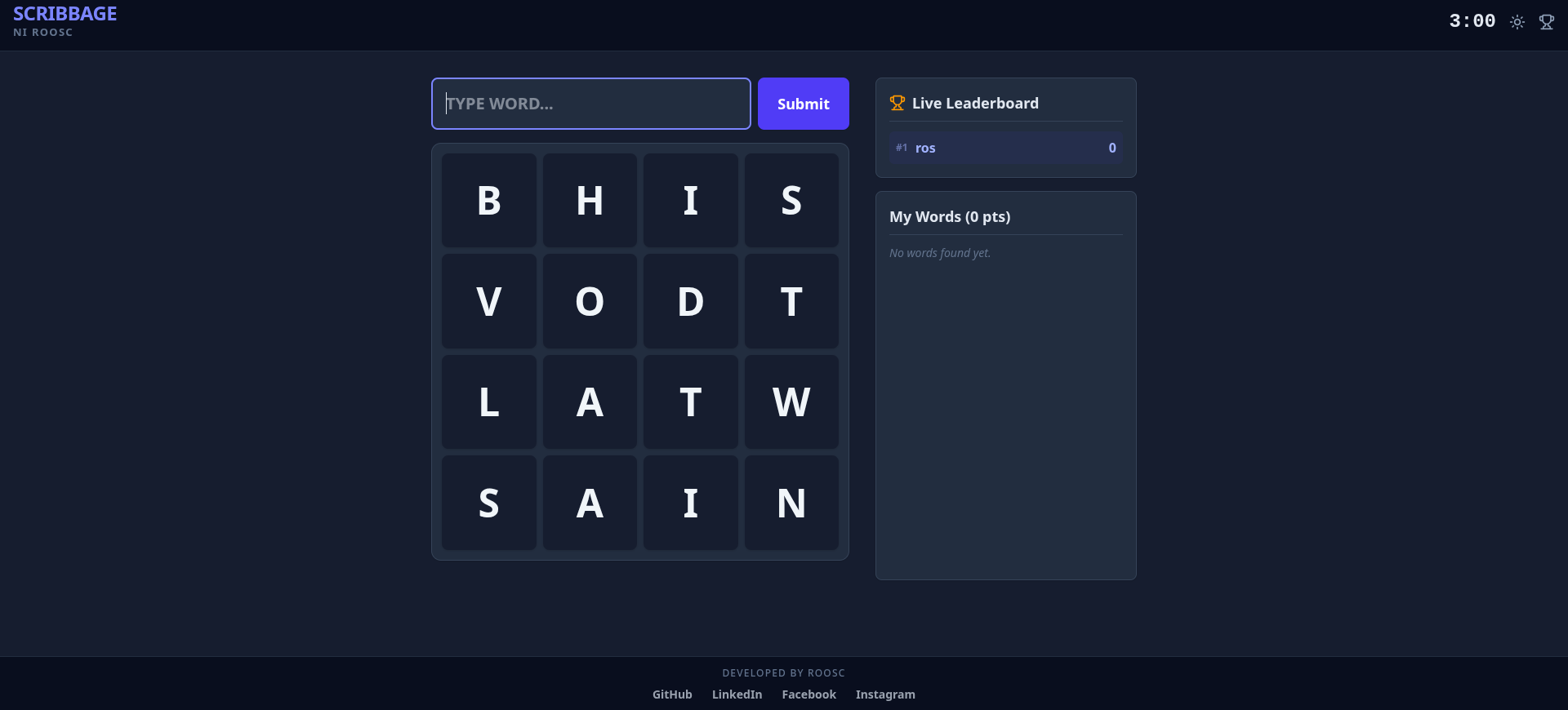
Scrib is a practice game for timed word-building rounds at the MSEUF English Festival. Players use the letters on a shared 4x4 dice board to form words in any order, using each tile once. Synchronized rooms support up to four players.
What I built
- Used an agentic development workflow with OpenAI Codex and Google Antigravity to build multiplayer rooms with a shared randomized 4x4 dice board, timed rounds, and live score updates.
- Guided and reviewed server-side validation against the TWL06 dictionary, with each board tile usable once and Q supplying QU.
- Added a post-round solver that lists playable words players missed, ordered by score and then alphabetically.
Technical approach
- Real-time State Sync: Django Channels broadcasts room state and game events to connected players over WebSockets.
- Word Validation: The backend checks dictionary membership and verifies that each word can be made from the board’s available tiles, using each tile once. A Q tile supplies the letters QU.
- Missed-Word Solver: The backend checks TWL06 dictionary entries against the board’s available tiles, then sorts playable words by score and alphabetically for the post-round summary.
- Client Architecture: The React and TypeScript client renders the board, timer, input, and scores from the room’s live events.
Security and verification
- The backend validates submitted words and calculates their scores, so client state cannot award unverified points.
- A submitted word must exist in the dictionary and be makeable from the available board tiles; the backend also calculates the score.
Current limits
- The current release uses an in-memory Channels layer and SQLite; persistent leaderboards and multi-server rooms would need shared channel storage and durable match data.