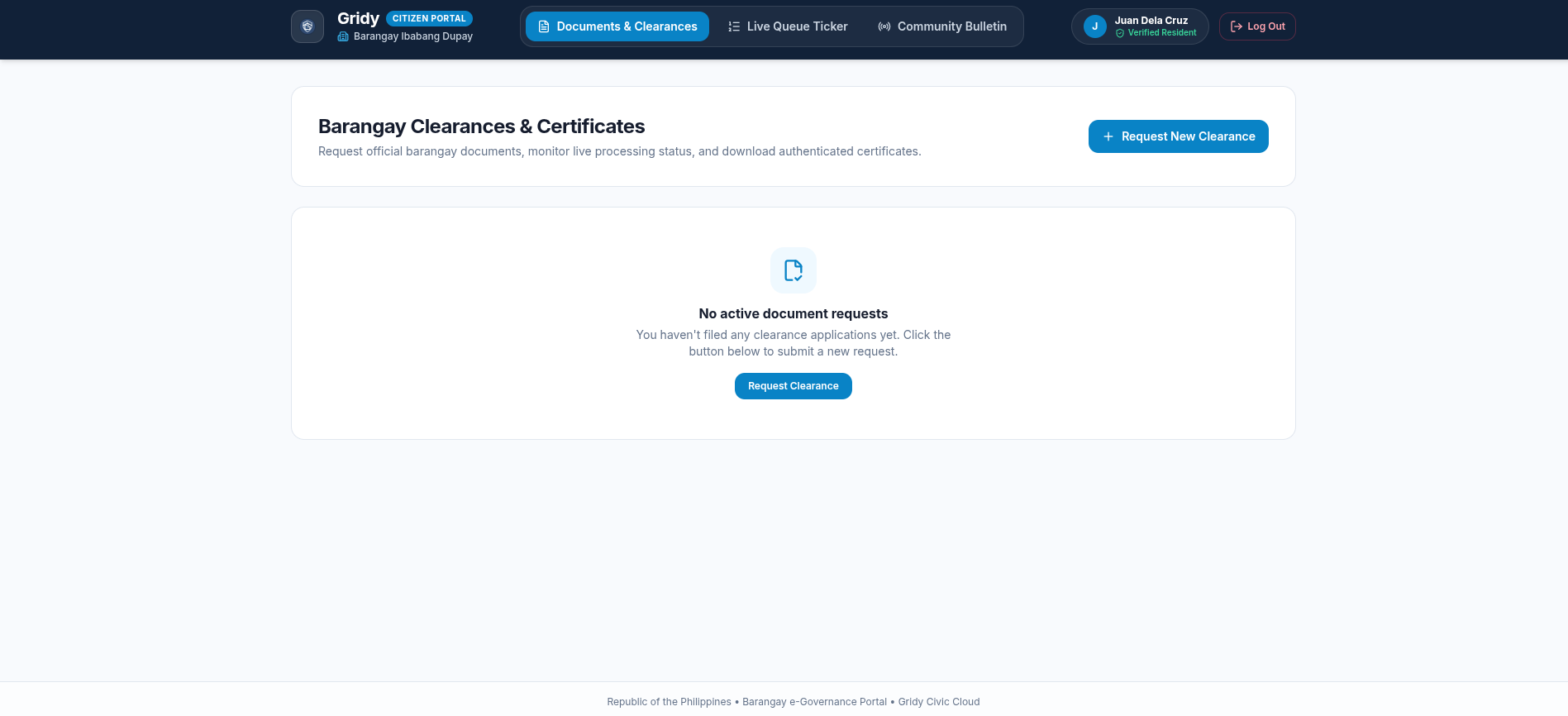
Context
Barangay residents and local administrators require separate authorization scopes for certificate issuance, dispute tracking, and emergency bulletins while guaranteeing citizen data privacy across web and mobile clients.
What I built
- Architected policy-protected Django REST Framework endpoints managing citizen identity verification, document applications, urgency-tagged issue reporting, and announcements.
- Implemented secure authentication with HttpOnly JWT cookies, refresh-token rotation, and automated audit logging for administrative accountability.
- Integrated Firebase Cloud Messaging (FCM) for sub-second emergency broadcasts and Cloudinary for authenticated document proof storage.
Technical approach
- OpenAPI schema contracts serve as the single source of truth between the Django REST backend and client platforms (React admin dashboard and Flutter mobile app).
- Role-Based Access Control (RBAC) is enforced at the serializer and viewset layers, guaranteeing that resident accounts can never read or mutate other households’ records.
- File attachments (e.g. proof of residency, municipal certificates) are sanitized and validated for MIME types before streaming to cloud storage to prevent unauthenticated server exhaustion.
- Relational database tables enforce referential integrity across fee schedules, document issuance statuses, and audit timestamps.
Security and verification
- Access tokens are retained in volatile client memory while refresh tokens are set exclusively as
HttpOnly,SameSite=Strictcookies. - Backend views implement rate limiting and request payload validation to prevent automated spamming on public request endpoints.
- Automated Django test suites verify role separation, authentication transitions, token rotation, and permission denial boundaries.
Current limits
- Capstone system evaluated using synthetic barangay datasets. Formal institutional deployment requires municipal LGU infrastructure provisioning.